
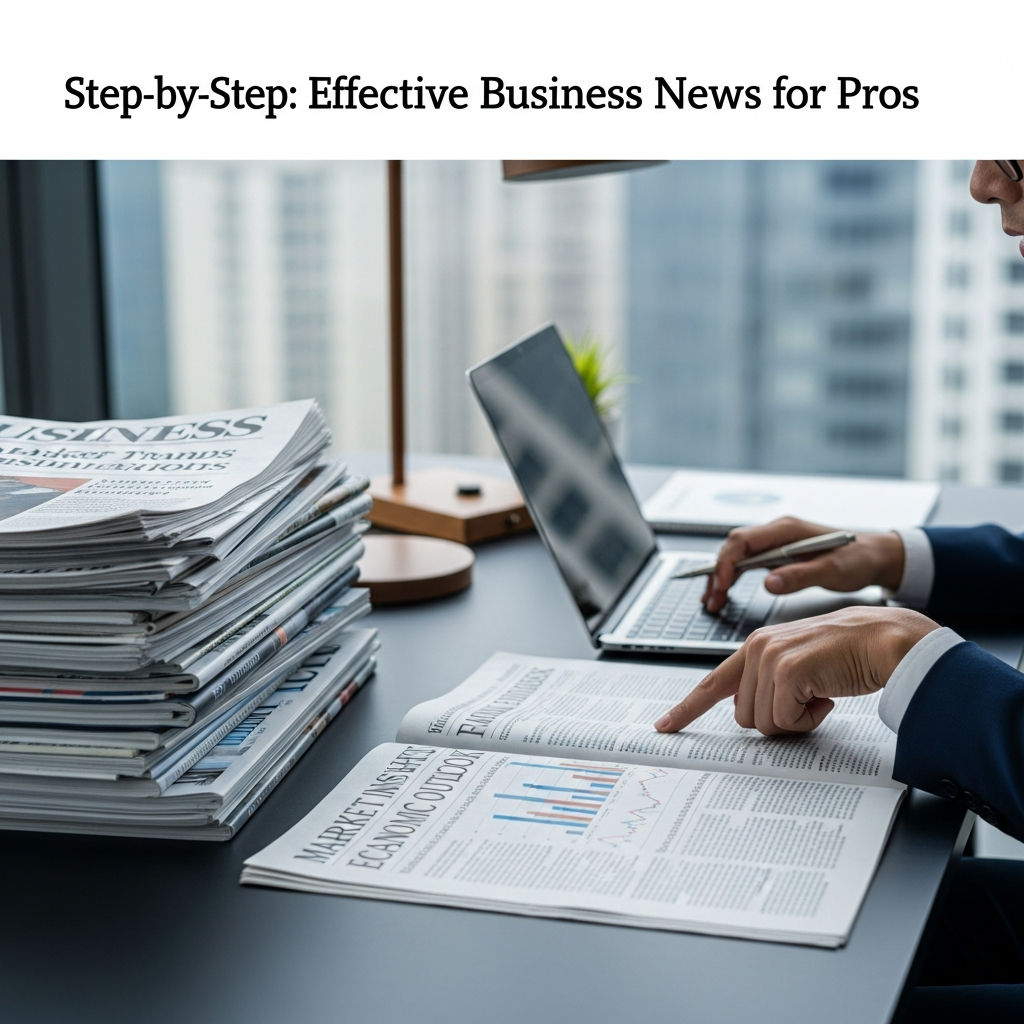
Step-by-Step: Effective Business News for Pros
In the modern corporate landscape, information is the most valuable currency. However, we live in an era of unprecedented data saturation. For the busy professional, the challenge is no longer finding information; it is filtering out the noise to find the signals that actually impact the bottom line. Consuming business news effectively is the difference between being a passive observer and a proactive leader.
This guide provides a step-by-step framework for mastering business news. By the end of this article, you will have a strategy to transform your daily reading habit into a powerful engine for decision-making and competitive advantage.
Step 1: Define Your Information Objectives
Before you open a single app or newsletter, you must define why you are consuming business news. “Staying informed” is too vague a goal for a professional. Your objectives should be categorized into three distinct buckets:
- Direct Impact: News that directly affects your current projects, company, or industry (e.g., a competitor launching a new product).
- Macro Trends: Broader economic or geopolitical shifts that could impact your long-term strategy (e.g., interest rate changes or trade policy shifts).
- Personal Growth: Insights into leadership, management, or productivity that help you evolve as a professional.
By categorizing your needs, you can allocate your time effectively—prioritizing direct impact news over general interest stories.
Step 2: Curate a High-Signal Source Portfolio
Not all news sources are created equal. Professionals need to move beyond “general news” and build a curated portfolio that balances breadth and depth. A robust portfolio should include:
The “Big Three” for Macro Context
Mainstream financial outlets like The Wall Street Journal, The Financial Times, and Bloomberg provide the global context. These are essential for understanding the broader market sentiment and large-scale economic movements.
Niche Industry Publications
General news often misses the nuances of specific sectors. Whether you are in Fintech, Healthcare, or Manufacturing, you should subscribe to trade journals and specialized newsletters (e.g., TechCrunch for startups, BioPharma Dive for pharmaceuticals). These sources offer “insider” knowledge that mainstream media lacks.
Primary Data and Regulatory Filings
Pros don’t just rely on reporters; they go to the source. Effective news consumption involves checking SEC filings (10-Ks, 10-Qs), earnings call transcripts, and white papers from reputable consulting firms like McKinsey or Gartner. This removes the “editorial spin” and gives you raw data.
Step 3: Implement an Efficient Scanning Technique
Professionals rarely have an hour to read a single article. To be effective, you must master the art of the “pro-scan.” Journalists write in an “Inverted Pyramid” style, meaning the most critical information is at the top. Use this to your advantage:
- The Headline and Lead: These usually contain the “Who, What, Where, and When.” If these don’t align with your objectives, stop reading.
- The Nut Graph: Usually the third or fourth paragraph, this explains the “Why” and the significance of the story.
- Subheadings and Bullet Points: Use these to jump to the sections that contain data or quotes relevant to your field.
- The Conclusion: Often contains insights into “What’s next,” providing a forward-looking perspective.
Step 4: Connect the Dots (Synthesizing Information)
Effective news consumption isn’t just about reading; it’s about synthesis. When you read a piece of news, ask yourself three critical questions to turn information into intelligence:

What are the second-order effects?
If a news report says oil prices are rising, don’t just think about fuel costs. Think about how that affects plastic manufacturing, logistics surcharges, and ultimately, your company’s shipping margins.
Does this contradict my current strategy?
Confirmation bias is a professional’s greatest enemy. Actively look for news that challenges your current business assumptions. If you believe your market is expanding, but recent data shows a decline in consumer confidence, you need to re-evaluate.
Who else needs to know this?
News is a tool for networking and leadership. If you find a piece of information that affects a colleague’s department, sharing it adds value to your professional relationships and ensures the whole organization stays agile.
Step 5: Leverage Modern Tools for Curation
In the digital age, you shouldn’t have to go looking for the news; the news should come to you. Use these tools to automate your intelligence gathering:
- RSS Aggregators (e.g., Feedly, Inoreader): These allow you to follow hundreds of websites in a single, clean interface, categorized by topic.
- Newsletter Managed Folders: Use an email alias or a tool like Stoop to keep business newsletters out of your primary inbox, ensuring you only read them during “deep work” or designated learning blocks.
- AI Summarizers: Tools that use LLMs (Large Language Models) can summarize long reports or transcripts into five key bullet points, saving hours of reading time.
- Social Media Lists: Don’t scroll your general feed. Create Twitter/X or LinkedIn lists of thought leaders, regulators, and competitors to see real-time updates without the distractions.
Step 6: Move from Information to Action
The ultimate goal of effective business news is action. If you consume news for two hours a day but change nothing about your work, you are merely “procrastinating with purpose.” To avoid this, implement an “Action Trigger.”
Every Friday, review the most important news you encountered that week. Choose one piece of information and turn it into a concrete action. This could be:
- Updating a financial forecast based on new economic data.
- Sending an email to your team to brainstorm a response to a competitor’s move.
- Adjusting your investment portfolio or departmental budget.
- Pitching a new project that capitalizes on an emerging trend.
Conclusion: The Competitive Edge of the Informed Professional
In a fast-paced global economy, the window of opportunity is often small. Those who can identify shifts in the market, regulatory changes, and emerging technologies before their peers are the ones who lead. By defining your objectives, curating your sources, and focusing on synthesis rather than just consumption, you transform “the news” from a daily distraction into a strategic asset.
Remember, the goal is not to know everything—it is to know what matters. Start small: audit your current sources today, unsubscribe from the fluff, and focus on the high-signal information that drives your career and your business forward.